Fundamentals · Chapter 5 of 12
Choosing a power rack you can build around
The rack is likely to stay longer than most of your attachments. Give yourself room to use it, and a sensible route to the upgrades you want.
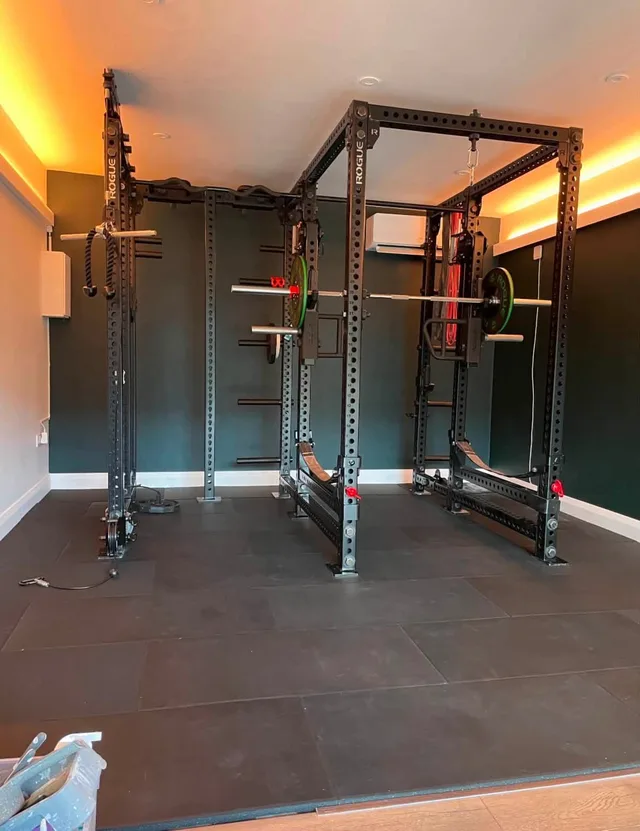
Start with how you’ll use it
My gym went from a Mirafit M3 to Rogue Monster racks, through an Extreme Fitness and Rogue hybrid, and eventually to a REP Ares 2.0 setup. The Frankenrack phase was real. It’s also why attachment compatibility gets so much attention on this site.
First, choose the layout that works in your room: full rack, half rack, stands or folding rack. Allow for the bar, plates and bench as well as the frame. Decide where you’ll lift and where the safeties will sit. Follow the anchoring and stability requirements for that exact setup, especially with attachments hanging off the front.
Write down the mounting measurements
The three starting points are upright box section, hole diameter and hole spacing. If an attachment spans two uprights, the distance between them matters too. Height, depth, generation and which face the holes sit on can rule out a particular attachment even when the headline sizes look right.
For example, REP lists the PR-5000 with nominal 3 × 3-inch uprights, 1-inch holes and 2-inch spacing. Mirafit lists M4 uprights as 75 × 75mm. Those are the manufacturers’ stated sizes, not proof that the attachments interchange. Nominal imperial sizes, actual measurements and bracket tolerances still matter.
Look at the attachments before buying the rack
Pick a few upgrades you can genuinely see yourself using. You don’t need to buy them now, but it’s worth knowing whether the rack supports them. A J-cup has a relatively simple mounting job; a complete cable system may depend on rack height, depth and post layout.
Use the attachment finder to narrow things down, then read the fitting conditions for the exact versions. An owner’s successful setup can be useful evidence, but it isn’t manufacturer approval or a load rating. Where a critical measurement is missing, ask rather than guessing. That’s less exciting than ordering another attachment, admittedly, but usually more useful.
Sources & further reading
Source pages checked 24 October 2026.
Something missing? Send a suggestion or correction.